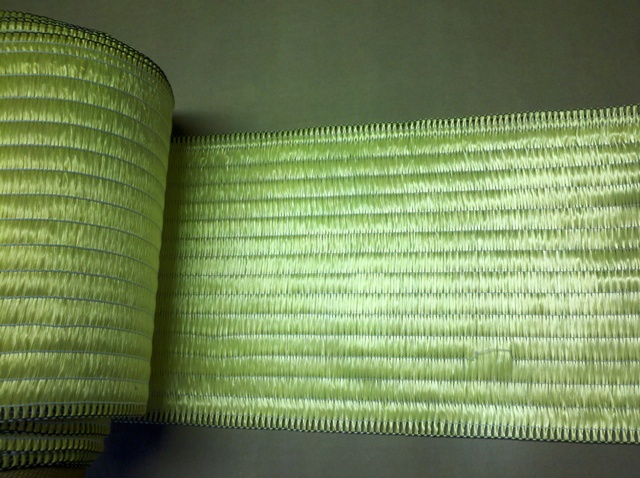
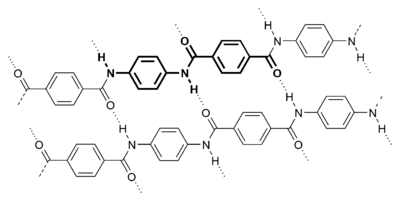
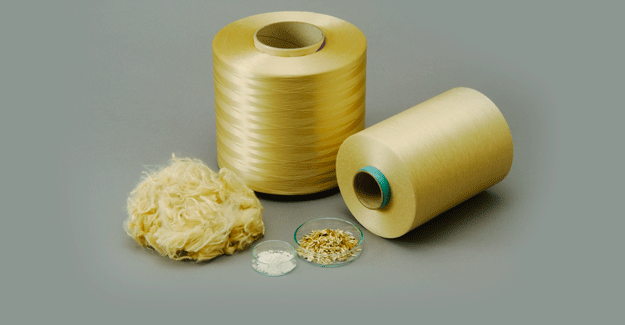
INTRODUCTIONAramid fibres are man-made high-performance fibres. They are man-made fibres with a chemical structure that makes them highly resistant to chemicals. They have molecules that are characterized by relatively rigid polymer chains. These molecules are linked by strong hydrogen bonds that transfer mechanical stress very efficiently, making it possible to use chains of relatively low molecular weight.
The term “Aramid” stands for äromatic polyamide”.They were first applied commercially in the early 1960’s.
Specialty OF ARAMID FIBRE FABRICS
The modulus of elasticity of these fibres can range from 60 to 140 GPa,
Tthe strength reaches a value of 4.5 GPa at 2.5 cm gauge length with an elongation at break of more than 4%.
It has a Low Density of 1.44 gm/cm3
It has a Negative Coefficient of linear expansion: -4.3 x 10⁶ (-2.4 x 10⁶).
It has a Low Dielectric Constant of 4 at 1 MHz offering good radar transparency.
It has an Excellent Tensile Strength of 3620 MPa (525 ksi)
It has a Good Stiffness of 131 GPa (19 msi)
It has an Excellent Toughness.
A high resistance
CHARACTERISTICS
High strength
Good resistance to abrasion
Good resistance to organic solvents
Non-conductive
A high melting point at 500 degree
Low flammability
Good fabric integrity at elevated temperatures
High Strength to weight ratio
APPLICATIONS
It is spun into yarn to make protective fabrics and garments
Arc flash protection
Flashfire protection
It is used in military, firefighting, auto racing etc.
It also finds usage in aerospace, the automotive industry(brake linings, tires), industrial applications(hoses and belts), and building materials.
It is used in ballistic applications.
DISADVANTAGES
It is sensitive to moisture. They pick up moisture very easily, so must be kept dry and need to be fully resin impregnated when moulded.
Aramid fibres are degraded by UV light. They must be coated with a resin layer, gel coat or paint.