When test specimen break, they tend to recoil along the line of their axis, so the danger zone from recoil is mostly in line with the rope.
Standing in line with the rope or either end of the test equipment should not be allowed within some distance greater than the length of the specimen. On rare occasions, breakage occurs in one leg of an eye splice and the rope may whip to the side.
Fittings and machine parts:
One of the greatest danger is the breakage of machine parts or fittings used for testing.
Metal objects propelled by the rope specimen are the most dangerous and most unpredictable as to direction.
Operators must be certain that the equipment has been designed with adequate safety margins relative to the maximum forces that can be exerted, with appropriate consideration for fatigue if the equipment is to be used extensively at high loads.
Impact against the test Equipment:
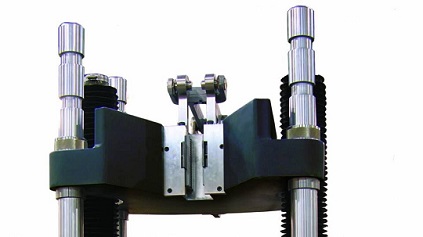
When a rope recoils upon breaking, the structure of test equipment must absorb the energy. Broken welds may appear in the structure so regular inspection is required.
Most test frames are designed for compressive loads but recoil impact is in the opposite direction and under shock conditions.
Protective barriers:
Cages over the testbed are appropriate, but they must not be considered “bullet-proof”, especially for large ropes that may have a strength and to as much as 1000 tonnes.
Broken fittings or metal objects are the most dangerous, and although breakage is rare, they can easily tear through most cages that have been installed over test beds.
Testing Strength evaluation dominates, by far, all the tests that might be run on fibre ropes. This seems obvious since when anyone thinks of any kind of rope, the first thing that comes to mind is, ‘How strong is it?’. However, there are many other tests that are conducted to measure the various properties of fibre ropes or those of the fibres from which they are made. Some of these properties may be more important than strength alone in certain applications.
Reasons for testing
Background: The reasons for conducting tests are as varied as the tests themselves. This background is useful for gaining an appreciation of the significance of testing in the developments, production, and use of the rope. Some of the more important tests are discussed in other points.
Quality Assurance: An acceptable quality assurance programme for rope production requires frequent type treatment, performance specification, and size. During the various stages of production, the ply count and twist levels of the rope components should be checked at some specified frequency.
Design and Specification: Fibre ropes often cannot be reliably designed to meet a specific strength specification without verification by testing. Unless changes from a known design are relatively small, knowledge of just the fibre properties may not be enough to accurately predict the strength of a new product. Also, strength will vary with size but not always in ratio with the amount of fibre present in cross-section.
Residual Strength: All Fibre ropes gradually lose strength and extensively with use. Knowledge of rates of degradation is important for safety and economy. A number of tension-tension fatigue tests on large ropes have been carried out in the joint industry studies sponsored by offshore oil-related organizations interested in deep sea mooring. These have been useful in gaining an understanding of the behavior of the particular ropes that were tested in this specialized application.
Research or Special Applications: Testing for various forms of fatigue and creep is usually done under research programmes to make life predictions. Sometimes a test programme will be undertaken for one specific application, such as deep sea mooring of floating oil production platforms.