Facilities SPLICING February 6, 2018 azuka-admin Fibre Rope Termination For a rope to transmit force it needs a termination, whether it is a permanent attachment, such as a splice, socket or mechanical grip, or a temporary fix, such as a knot or wraps around a post. An effective termination is essential to almost every application that puts a rope under tension. Splicing Splicing can be used in three ways. An eye spice puts a loop in the end of a rope. An end-to-end splice can either join two ropes together or, finally, join two ends of the same rope to make a circular grommet. Fibre rope splicing is a skill that must be learned. The simpler splices can be produced by carefully following a manual. Small practices that are learned from experience or by testing of the splices are often needed to produce the best results. A well-practiced expert can make splices that match rope strength. The most common and one of the most dependable methods of terminations of the fibre ropes is an eye splice, which can be placed round a suitable fitting. Splices are made by separating the strands at the ends of the rope from the structure, bending the rope into a loop and tucking the separated strands into the body of the rope. Another approach is to separate the strands, create an eye, and then braid them over the exterior of the rope; this over-braid will tighten and grip as tension is applied at the eye. An intermediate stage of tucking the strands is an eight-strand plaited rope. There is enough grip on the tucked strands to hold considerable tension, usually to the maximum breaking strength of the rope.
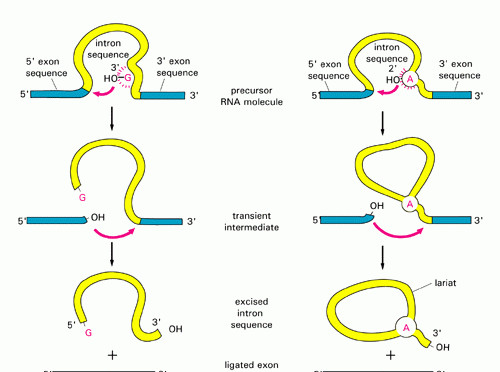
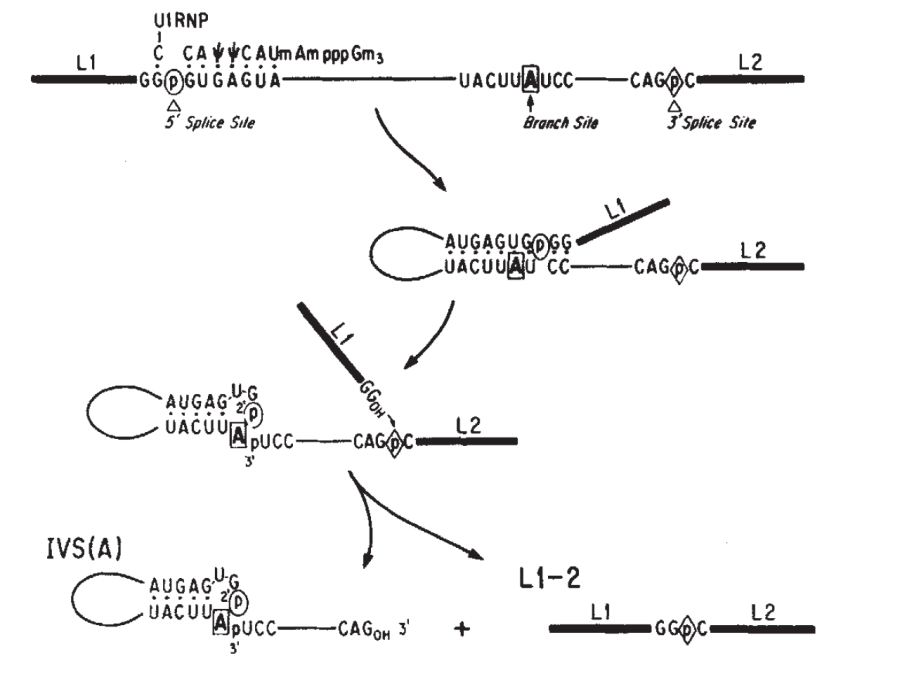
Azuka Blog RNA Splicing February 5, 2018 azuka-admin RNA splicing In molecular biology, splicing is the editing of the nascent precursor messenger RNA (pre-mRNA) transcript into a mature messenger RNA (mRNA). After splicing, introns are removed and exons are joined together (ligated). For nuclear-encoded genes, splicing takes place within the nucleus either during or immediately after transcription. For those eukaryotic genes that contain introns, splicing is usually required in order to create a mRNA molecule that can be translated into protein. For many eukaryotic introns, splicing is carried out in a series of reactions which are catalyzed by the spliceosome, a complex of snRNPs. Self-splicing introns, or ribozymes capable of catalyzing their own excision from their parent RNA molecule, also exist. Self-splicing occurs for rare introns that form a ribozyme, performing the functions of the spliceosome by RNA alone. There are three kinds of self-splicing introns, Group I, Group II and Group III. Group I and II introns perform splicing similar to the spliceosome without requiring any protein. This similarity suggests that Group I and II introns may be evolutionarily related to the spliceosome. Self-splicing may also be very ancient and may have existed in an RNA world present before protein. Two transesterifications characterize the mechanism through which group of introns is spliced: 3’OH of a free guanine nucleoside (or one located in the intron) or a nucleotide cofactor (GMP, GDP, GTP) attacks phosphate at the 5′ splice site. 3’OH of the 5′ exon becomes a nucleophile and the second transesterification results in the joining of the two exons. The mechanism in which group II introns are spliced (two transesterification reaction like group I introns) is as follows: The 2’OH of a specific adenosine in the intron attacks the 5′ splice site, thereby forming the lariat The 3’OH of the 5′ exon triggers the second transesterification at the 3′ splice site, thereby joining the exons together.