Category Archives: Azuka Blog

Rope Production

Production of rope

The sequence of rope production:
At its very simplest, making a rope consists of plying yarns, often by twisting, and re-twisting the plied yarns together to make substructures such as strands. These, in turn, are assembled and twisted or braided into ropes. Finally, in some ropes, an external jacket is provided, generally by braiding, but occasionally with an extruded plastic jacket or even a combination of both. The basic steps in making a rope can thus be listed as:
  • Yarn manufacture
  • Plied yarn assembly
  • Strand manufacture
  • Rope manufacture
Starting Material:
The starting materials for rope production are yarns, monofilaments, tapes or slit film. Most of the yarns used by the rope industry are multifilament yarns, which are composed of synthetic fibres in the form of continuous filaments. There is still some use of traditionally spun textile yarns, which are made by assembling short natural fibres, with some use of synthetic staple, which is converted into yarns in a manner similar to spinning natural fibre yarns.

Twisting theory & practice: Surprisingly the theory of rope manufacturing is not simple. There are a number of issues related to twisting, of which the most vexed question is that of backtwist.
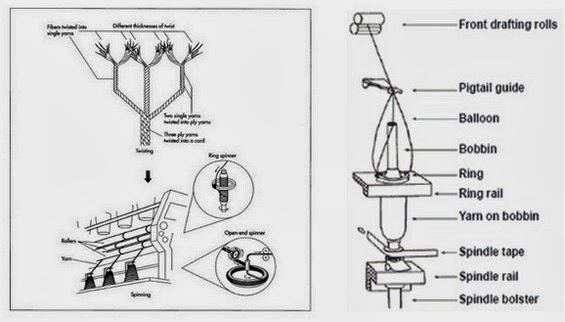
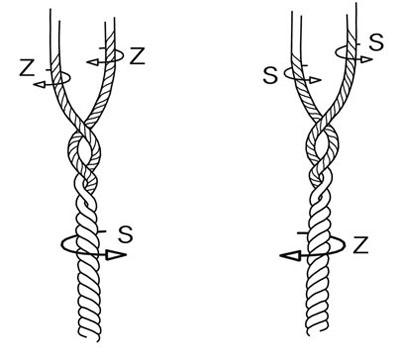
Twist can be either left handed or right handed. In the textile industry, these are referred to as S or Z twist. Most commonly, successive twisting operations alternate twist directions. Rope making involves twisting textile yarns into rope yarns, rope yarns into strands, and strands into ropes.
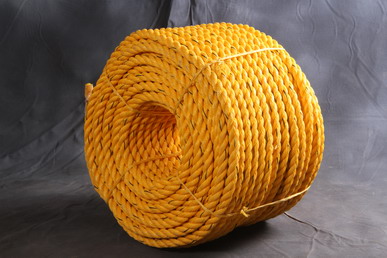
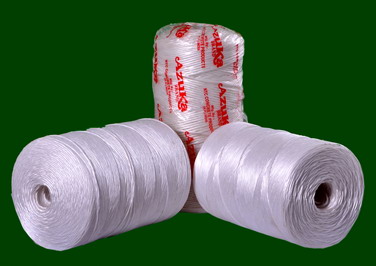
Some more properties of the Ropes

Some more properties of the Ropes
Shrinkage
Nylon ropes can be ‘shrunk’ by processing the rope through steam. The swelling of the fiber expands the diameter, shortens the rope & increases the extensibility.  The steam process makes the rope very firm & resistant to further ‘shrinkage’. As a property, this is preferred by some users. Polyester fiber can be shrunk by heating. At the higher end of working loads, it will give a rope more elongation on the first few cycles but this soon disappears due to the shrink effect being permanently removed. In the Double braid, a core made of heat-treated polyester will permanently elongate as the rope is loaded to high tension, thus transferring more load to the cover, a modest increase in break strength can be attained compared with producing the entire rope out of the untreated fiber. This shrink effect may also have the application where higher extensibility is required for one-time use.
Spliceability
The ability to be spliced with relative ease can be an important property of any rope. For many applications, the capability to form an eye in the end of the rope as a termination is essential. To be truly spliceable, the procedure should be standardized for the general purpose uses and carried out with a modest amount of training, skills & tools. Some used ropes, although spliceable when new, cannot be spliced after considerable use or shrinkage, or the splices, if made, can be very weak. Nylon braids that have shrunk fall into this category. Almost any rope can be spliced, but specialist skills and tedious procedures are often required. Unless tested, efficiency and reliability may be questionable.
Knot Retention
Knot retention can be an important property for certain applications. Tree service operators, rescue crews, mountain climbers & homeowners trying to secure a ladder use knots. No one wants them to slip. Some ropes hold better than others. Below, are some comments on ropes types:
  • Manilla fiber ropes are “excellent”
  • Eight strands plaited ropes that are tightly twisted & plaited are “good”
  • Polypropylene staple ropes are “good”
  • Nylon three-strand & braids are “poor”
  • Polyester continuous filament braids are “fair”
  • Polyester with staple(fuzz) on the surface is “good”
  • Polypropylene monofilament three stand & braids are “poor”

Hardness
Three strands laid ropes may be produced in hard, medium or soft lay. Tightly twisted strands and short lay length will produce a hard rope which is very firm, not very flexible and more snag resistant than the other versions. The soft lay rope is stronger and floppy. Medium lay is most common. Plaited ropes are sometimes specified with a hardness req

External Abrasion resistance

external abrasion resistance EXTERNAL ABRASION RESISTANCE External Abrasion resistance is the property of the rope which gives it the the ability to resist damage from abrasion due to rubbing on exterior surfaces is an important property. It depends upon:-
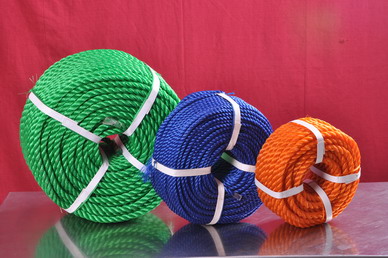
  • The fibre material
  • Wet or dry conditions
  • Finish on the fibre
  • The rope construction
  • Nature of the abrasive surface
  • Tension in the rope
  • Pressure on the abrasive surface
  • Speed of sliding over the surface
There is no standard for quantifying the abrasion resistance. Some generalisations can provide guidance:-
  • Polyester especially if treated with a good marine finish resists abrasion well.
  • Nylon is good or dry, poor wet, unless treated with a marine finish which provides improvement.
  • Aramid is a good performer, wet or dry, but lubricants and marine finishes give better performance.
  • HMPE is very abrasion and cut resistant but due to low melting point it can give poor performance if the combination of pressure and speed creates heat.
  • Polypropylene is fair to good depending on type and filament size.low melting point is a disadvantage. Blends with polyester perform much better.
  • LCP has a very good abrasion resistance.
  • Manila is fair but degrades with age.
  • Surface yarns and strands should approximately align with the axis of the rope.
  FRICTION The coefficient of friction between ropes and other surfaces is an important consideration in many applications. Frictional heat can cause fibres with low melting points to melt which can lubricate the friction surface reduce the coefficient to near zero and create a dangerous situation. Friction is also essential to make a splice work. Friction coefficients are variable difficulty to quantify and are usually stated as a range the variable are:-
  1. fibre material
  2. surface material
  3. surface conditions
  4. finish on the rope fibre
  5. pressure against a surface
  6. wet or dry-friction coefficient usually increases if the rope is wet.
  7. static or dynamic.

Properties of Rope

Properties of Rope
Rope Dimensions: In order to discuss properties of Rope, we should define the rope size that can be considered as an approximate starting point. A diameter of approximately 4mm is usually taken as the lower limit, which differentiates rope from small cords, and the largest ropes now made approach 300mm. The Range is thus from the first few divisions of an ordinary ruler to its whole width. However, the diameter is an uncertain measure of rope size, because of the irregular boundaries of ropes and the variable spaces between fibres, yarns and strands. Rope size is best expressed in terms of its linear density, i.e. mass per unit length.
Strength and Weight: Strength is the first measure that comes to mind when we consider the properties of Ropes. Fibre rope engineering normally normalizes strength in terms of weight, so that strength & weight should be considered together. There is an important mechanical quantity, known as breaking load, commonly expressed in Kilogram- force, kiloNewtons(102kgf), tones(1000kgf) or pounds force. The properties are best expressed in terms of linear density, but can also be expressed in Pascals, pounds force per square inch or other conventional stress units which are normalized by area. Nylon and polyester ropes in three-strand laid, eight-strand plait and various braids are produced for demanding service with strengths about 15% higher than the ordinary ropes.
  • Minimum Strength: The breaking load values are for minimum strengths. This is defined in some standards as two standard deviations below the mean of a statistically significant no. of break-test results.
  • Termination Strength: In use, rope is only as strong as the means used to hold or anchor it at its ends; this is called the “termination”. The disturbance of rope structure to make a splice or the interface with the fitting inevitably weakens a rope at the termination.
  • Strength-to-weight ratio: This is a measure of rope tenacity & provides a quick view of weight relative to strength for comparison between various products. Wire rope has a lower strength-to-weight ratio by a factor of nearly two or more when compared with any synthetic fibre rope. For rope made of very high tenacity fibres, the factor can be over eight.
  • Submerged Weight: Using polyester parallel strand construction & wire rope is very nearly twice as strong, but its submerged weight is 20 times as great. Therefore, on a strength-to-weight basis, the polyester is 10 times better. This is significant for applications such as deepwater mooring where the submerged weight of wire rope becomes very difficult to manage.
  • Service Conditions: As some ropes may degrade faster than others, the safety margin might have to be increased for a very high strength line, as compared to one of lower strength which may have a much longer life at a larger diameter. Although everyone tends to look at strength first, the selection must view all aspects of the application.

Different types of Ropes

Rope: A rope is an article of cordage, more than approximately 4mm in diameter, obtained when: Three or more strands are laid or plaited together. A core is covered by a braided or plastic film Sheath. TYPES OF ROPES ARE:
  • Cable Laid Rope: A rope formed by three or more ropes twisted to form a helix around the same central axis. The ropes that become the secondary strands are “S” lay and the finished cable is “Z” lay or vice versa.
  • Combined Rope: A rope in which the strand centres are made of steel and in which the outer portions of each strand are made from the fibrous material.
  • Double Braided Rope: A rope in which a number of strands are plaited to form a core and around which are plaited further strands to form a sheath. The core lies coaxially within the sheath.
  • 8 Strand Plaited Rope: A rope normally composed of 4 pairs of strands plaited in a double 4-strand round sennit.
  • Hard Laid Rope: A rope in which the length of lay of the strands or the rope is shorter than the usual, resulting in a stiffer & less flexible rope.
  • Hawser Laid Rope: A rope of three strands which are twisted to form helixes around the same central axis.
  • Laid Rope: A rope in which 3 or more strands are twisted to form helixes around the same central axis.
  • Shroud Laid Rope: A 4-strand rope with or without a core with the strands twisted to form a helix around the central axis.
  • Soft Laid Rope: A rope in which the length of lay of the strands and/or the rope is longer than usual resulting in a more flexible rope which is easily deformed.
  • Spring Lay Rope: A rope made with 6 strands over the main core, each strand of which has alternative wire and fiber components laid over a fiber core.

HISTORY OF ROPES

HISTORY OF ROPES DID YOU KNOW? Some animals were the first to use ropes. They used the long strands of vines and other plants to climb trees and swing from one branch to another. Ropes are one of the oldest human artefacts. Ropes were made earlier in the history of mankind. However, these ropes made from organic materials would decay very easily. Natural rope fibres survive in waterlogged or very dry conditions. The earliest rope was made of papyrus in about 500bc.the hierarchical structure was similar to a modern 3 strand rope. The earliest record of making rope is on a tomb in Thebes from the Egyptian 5th dynasty which has the inscription”twisting the ropes for boat building”. ROPE MATERIALS
  • The rope makers in Thebes used strips of leather.
  • Ropes were made of heather in Orkney islands.
  • In luxury furnishings, silk ropes were used.
  • Ropes were also made from soft vegetable fibre or hemp.
  • Cotton was used for cheaper soft ropes.
  • Manila hemp or other materials were extracted from the leaves of tropical plants.
PRINCIPAL PROPERTIES OF ROPES
  • Ropes made from the natural fibres are attractive due to
    1. Ease of handling,
    2. Good gripping surface
    3. Knot retention
    4. Low recoil energy
    5. They are not melting
    6. Low cost
  • Ropes made from the synthetic are attractive due to:
  1. High Strength
  2. Ease of handling
  3. High Abrasion resistance
The ability to stretch under load can be a beneficial property. Many situations occur where shock loading may occur and the elasticity of the rope reduces the peak forces. Eg. Fall protection in mountaineering.

Ropes

A rope is a linear collection of natural or artificial plies, yarns or strands which are twisted or braided together in order to combine them into a larger and stronger form, but is not a cable or wire. Ropes have tensile strength and so can be used for dragging and lifting, but are far too flexible to provide compressive strength. As a result, they cannot be used for pushing or similar compressive applications. Rope is thicker and stronger than similarly constructed cord, line, string, and twine.

Rope may be constructed of any long, stringy, fibrous material, but generally is constructed of certain natural or synthetic fibres. Synthetic fibre ropes are significantly stronger than their natural fibre counterparts, but also possess certain disadvantages, including slipperiness.

Common natural fibres for rope are manila hemp, hemp, linen, cotton, coir, jute, straw, and sisal. Synthetic fibres in use for rope-making include polypropylene, nylon, polyesters (e.g. PET, LCP, HDPE, Vectran), polyethylene (e.g. Dyneema and Spectra), Aramids (e.g. Twaron, Technora and Kevlar) and acrylics (e.g. Dralon). Some ropes are constructed of mixtures of several fibres or use co-polymer fibres. Rope can also be made out of metal. Ropes have been constructed of other fibrous materials such as silk, wool, and hair, but such ropes are not generally available. Rayon is a regenerated fibre used to make decorative rope.

The twist of the strands in a twisted or braided rope serves not only to keep a rope together, but enables the rope to more evenly distribute tension among the individual strands. Without any twist in the rope, the shortest strand(s) would always be supporting a much higher proportion of the total load.

Baler Twines & its uses

Baler Twine

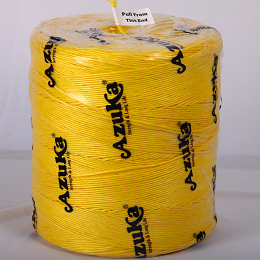
Baler is a bundle of raw or finished material that binds with twine. Twine is a strong fibre made of two or many strands of fibre. So the Baler Twine also known as Baling Twine is a thread having a small width and is composed of two or more strands of fibre twisted together which is used to bind many fibrous things into solid, compact and easily portable shape. Baler twine is a small diameter sisal or synthetic twine used to bind a quantity of fibrous material (notably hay or straw) into a more compact and easily stacked form.<br><br> In the late 18th century, the first automatic binder machine was invented. Originally binding was done manually with a wire than the automatic reaper machine was invented for this purpose. In the 19th century, baler twine is started to use for the binding purpose. Binder wires were created problems which lead to the invention of knotter, which later, called binder twine. In 1930’s, the first automatic baler machine was invented for binding bales of hay and straws. That machine used binder twine for their automatic knotter and then became common and known as baler twine. Today, many baler machines are used baler twine in agriculture and industry as it provides the safest way to bind raw and finished material in neat piles. Some examples are waste material, recyclable material, newspaper, cotton and textile. Baler twine is also available in different colours, strengths and material suitable to its use. These days, baler twine becomes the essential part of our industry. It also uses in craft-making these days and it is rough like a very thin piece of rope and can bear weight up to 350lbs. Uses of Baler  Twines:-
  1. Macrame Macrame cool plant hangars, coasters, rugs, wall hangings and other decorative items to give away as gifts. (Many clever horse owners have macraméd haynets from baler twine.) Binder twine is strong, so it will even last a summer outside holding your hanging plants.
  2. Clothes LinesKnot several lengths of binder twine together and replace your old clothesline.
  3. Collector’s items make a conversation piece by simply winding baler twine in a ball and marvel as it grows bigger and bigger with each passing week. I started one, but oddly it has gone missing…
  4. Streamers Make cool streamers from binder twine to tie to your truck antenna. Think also: streamers for birthday, wedding, shower, and Christmas decorating. This might be regarded as a time-saving tip as you will likely never be asked to help decorate again, thereby saving you time.
  5. Belts and Braces Need a belt and don’t have one? A length of baler twine is inexpensive and adds a rustic flair to your wardrobe. Scratch, scratch.
  6. Horse Equipment Braid several lengths of binder twine together to make inexpensive lunge lines, lead ropes and rope halters. No one will ever use them because they are too rough and picky, but they’ll look better hanging around the stable than hanks of ‘unorganized’ twine.(Although binder twine lead ropes might be rough on the hands, twine is just the thing to make breakaway tie loops from. I also use it to temporarily tie up feed buckets.)
  7. Costumes and Wigs Make a scary costume. My cousin once made a “Cousin It” costume using binder twine for hair. It was too heavy to wear, but it was a great idea. Other costume ideas: Lady Godiva, a sea anemone.
  8. Learn to Crochet Learn to crochet and make heavy-duty sweaters lap quilts and handbags. Seriously, you could crochet or weave sturdy mats from binder twine. Hint: Wear gloves.
Azuka is the leading manufacturer and supplier of baler twine in India.

About Polypropylene Rope

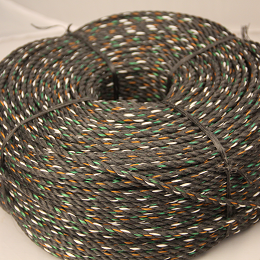
Propylene was first polymerized to a crystalline isotactic polymer by Giulio Natta as well as by the German chemist Karl Rehn in March 1954. This pioneering discovery led to large-scale commercial production of isotactic polypropylene by the Italian firm Montecatini from 1957 onwards. Syndiotactic polypropylene was also first synthesized by Natta and his coworkers. Polypropylene (PP), also known as polypropene, is a thermoplastic polymer used in a wide variety of applications including packaging and labeling, textiles (e.g., ropes, thermal underwear and carpets), stationery, plastic parts and reusable containers of various types, laboratory equipment, loudspeakers, automotive components, and polymer banknotes. An addition polymer made from the monomer propylene, it is rugged and unusually resistant to many chemical solvents, bases and acids. These ropes are tested for linear density, strength and elongation for every lot. They are also specially packed for fisheries use and they float on water. Various industrial applications like Fisheries, Marine, Agriculture, Transportation, Safety, Construction, Sugar Industry, Telecommunication Industries, Cargo Nets, Heavy lifting, safety line, anchor, etc. Most commercial polypropylene is isotactic and has an intermediate level of crystallinity between that of low-density polyethylene (LDPE) and high-density polyethylene (HDPE). Polypropylene is normally tough and flexible, especially when copolymerized with ethylene. This allows polypropylene to be used as an engineering plastic, competing with materials such as ABS. Polypropylene is reasonably economical, and can be made translucent when uncolored but is not as readily made transparent as polystyrene, acrylic, or certain other plastics. It is often opaque or colored using pigments. Polypropylene has good resistance to fatigue. 8 Strand Polypropylene Rope are primarily used for mooring, towing/typing or similar application. These ropes are made on the latest & modern machinery using latest technologies hence posses excellent standards & properties. Traditionally, three manufacturing process are the most representative ways to produce polypropylene. Hydrocarbon slurry or suspension: Uses a liquid inert hydrocarbon diluent in the reactor to facilitate transfer of propylene to the catalyst, the removal of heat from the system, the deactivation/removal of the catalyst as well as dissolving the atactic polymer. The range of grades that could be produced was very limited. (The technology has fallen into disuse). Bulk (or bulk slurry): Uses liquid propylene instead of liquid inert hydrocarbon diluent. The polymer does not dissolve into a diluent, but rather rides on the liquid propylene. The formed polymer is withdrawn and any unreacted monomer is flashed off. Gas phase: Uses gaseous propylene in contact with the solid catalyst, resulting in a fluidized-bed medium.

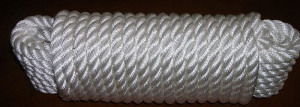
Uses of Nylon Rope

Nylon Rope is the most popular synthetic rope in use today.

Standard nylon is a good choice. It has great strength,gives under load to absorb energy, and is relatively inexpensive. It’s also easy to handle and resists the harmful effects of sunlight better than other synthetics. Three strand is usually used on anchor rodes because of its stretch and resistance to abrasion. Braided, more commonly seen on dock lines and in sailing rigging, will snag easier than stranded line, although it’s usually easier to handle and has great strength. Some types of stranded lines are softer than regular 3 strand and less desirable for boat use. If you see stranded nylon in a hardware store, for example, that’s very inexpensive, beware. Some types of braided lines are stronger and less subject to snagging. Don’t just buy rope. Read all the various product descriptions each time you buy to help you make the right choice.

Normal loading should be nowhere near a rope’s breaking strength, certainly no more than 25%. This means your lines will stay on duty even when stressed well beyond the service intended, resisting big wakes, strong winds, and other challenges. Remember that breaking strength decreases with age and wear and knots and kinks in the line will weaken it.

Nylon ropes are widely used in many gyms, especially those that have a large female membership. Nylon ropes are very flexible, soft to the touch, have a silky feel and are easy on your hands. This type of conditioning rope doesn’t fray and if used outdoors, holds up well to the elements. A few drawbacks to nylon ropes are that they can stretch over time and can unravel. Nylon ropes are generally available in white or black.

Nylon rope is a great choice for almost any demanding use you can think of and Quality Nylon Rope offers all standard sizes of nylon rope including some red nylon and blue nylon.