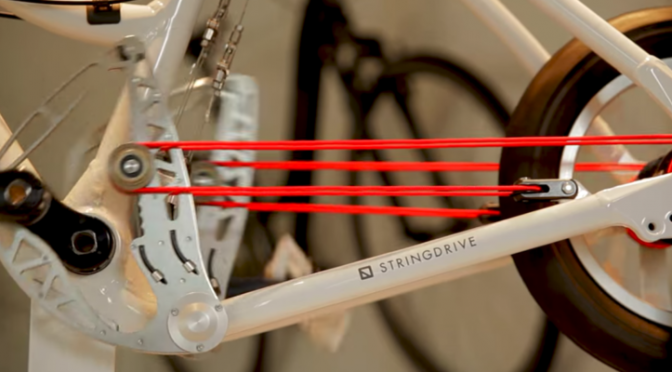
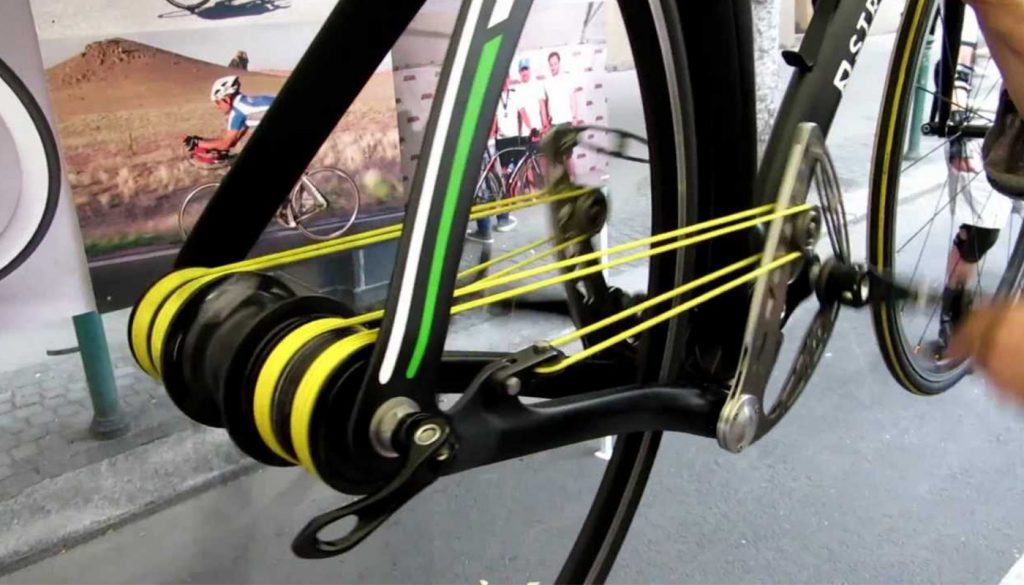
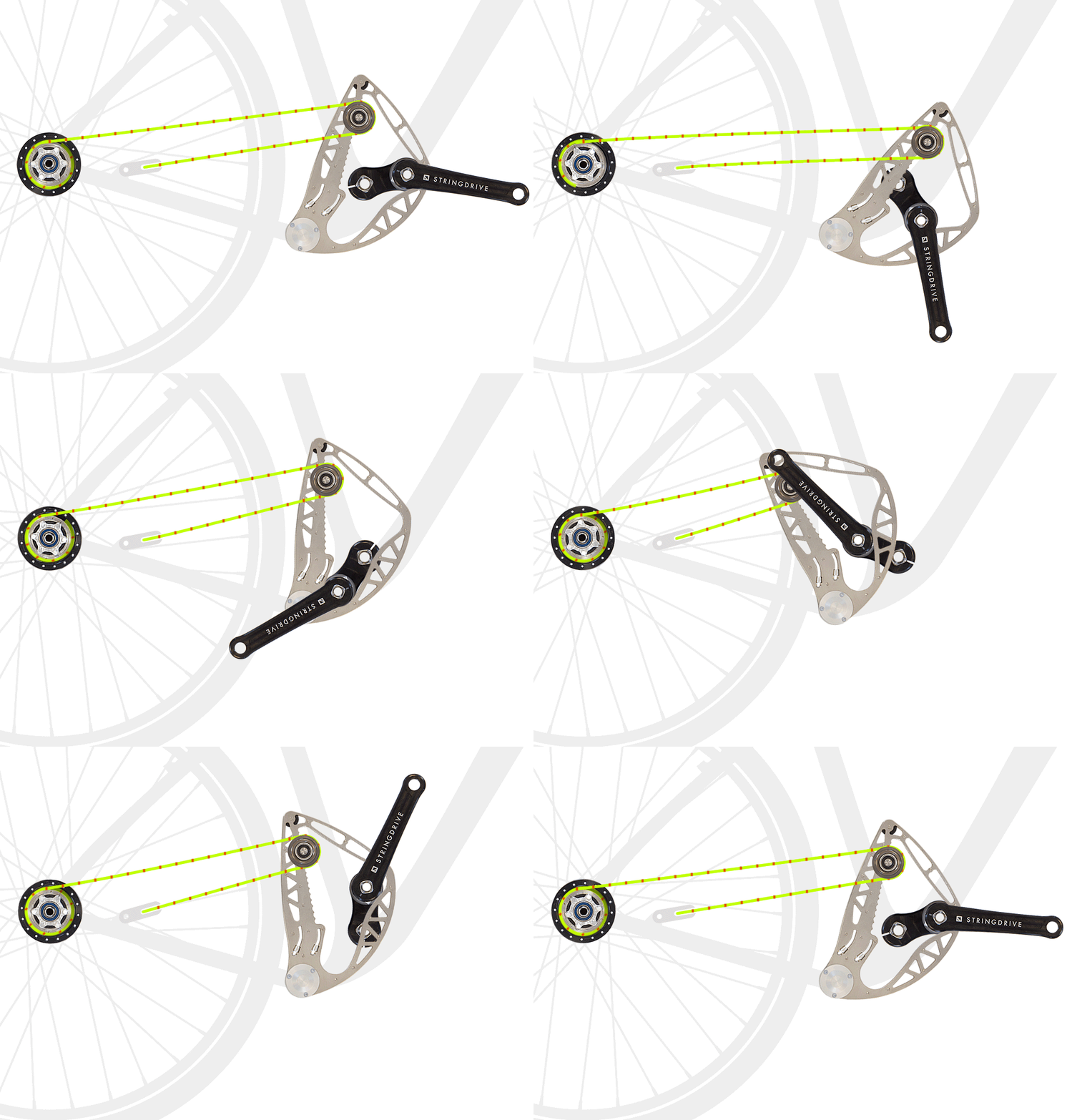
StringBike is a Hungarian company that has developed a bicycle that uses a rope and pulley drive system instead of a traditional bicycle chain. In the stringBike,the ropes are used on a bicycle instead of the chain and pulley method.Instead of being propelled by the traditional chain system, it is moved forward by the help of ropes and pulley system.Now the ropes are used in every sphere of life. Now bid farewell to the greasy chains and that chirping noise and welcome the fashionistas technology.Azuka is the leading manufacturer of Ropes, Twines and Nets in India and worldwide.
BENEFITS
It is a clean quiet and a graceful vehicle
The friction loss is minimal due to pure rolling motion used in it
Symmetrical and balanced transmission.
Low maintenance
High durability
Enhanced pedalling Experience
there are 19 gears
The strings transfer the leg power to the rear wheel in a smooth way.
The string bike uses a 19 gear ratio system.
The Gears range varies from 3.5 to 1.
The string is UV resistant and water resistant too.
String drive has enhanced the bicycling experience making it safer smoother and an efficient drive.
The ‘string’ is made of a high-density polyethene cord (HDPE)
The string does not slip when wet.
Azuka offers high-quality ropes by the use of the premium quality raw material.We are synonymous with quality.At Azuka, quality is never compromised.
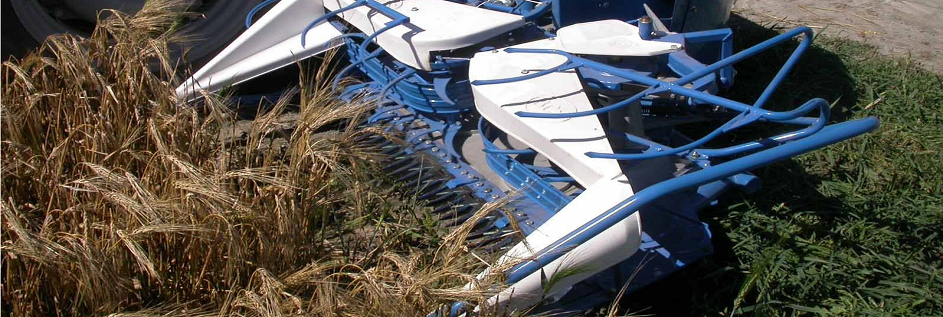
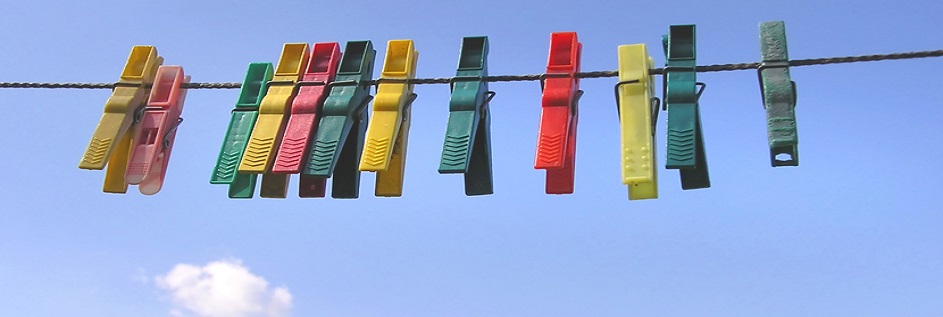
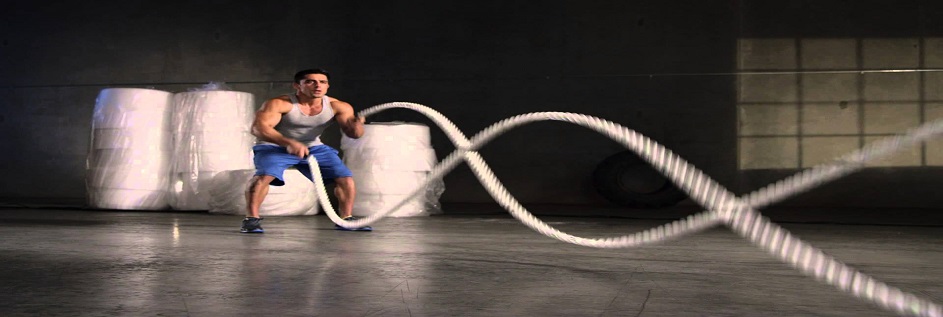
Right from decorating the interiors to the use in industries, Ropes have become the versatile product worldwide.Never leave any strand of thread wasted you never know where it finds its utility. Ropes and knots are among the most ancient and useful technologies ever developed by man, predating the wheel, the ax and probably also the use of fire.These days Ropes are used in every sphere of life. Their usage is indispensable in every sector of life. We are present in all the activities of your life.Reaper Binder Twine: The flour which people consume in all the meals of the day is usually of wheat. Azuka’s Reaper Binder Twine is used to tie the bundles of wheat during harvesting.To the numerous calls we do every day, the Telecom ropes are used for keeping the world connected.Electricity an indispensable source in our lives,the consumption of the electricity across the world is huge.For the proper flow of electricity,the Power Transmission Ropes are used.Clothesline Ropes: For drying of clothes, Clothesline Ropes are used for drying of the clothes.To deal with the journey of weight loss and fitness, The Battling ropes are used in gyms as well as for home fitness.Charpoy Rope used in urban as well as in rural areas these days. Conclusion:
A rope is a thread which has connected all the activities of our daily life.
Every sector of daily life is connected to each other with a “rope”.
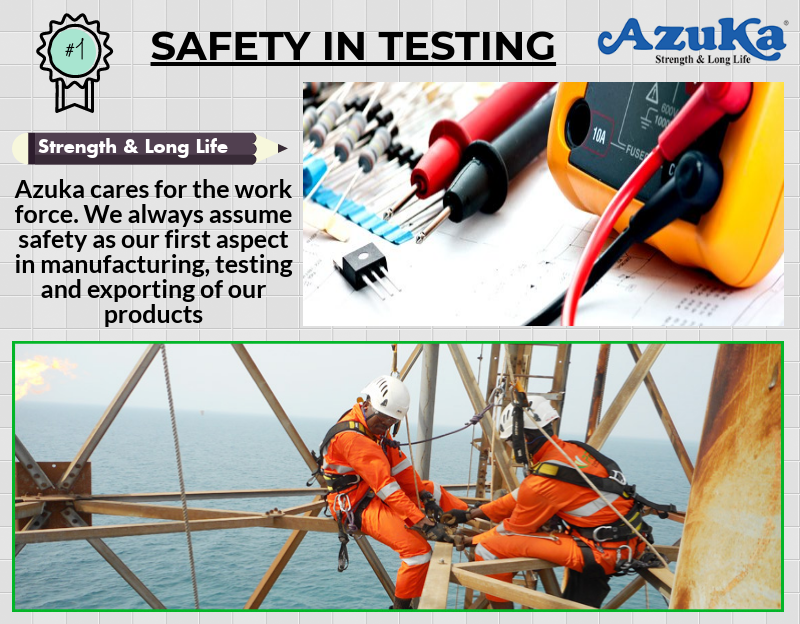
When test specimen break, they tend to recoil along the line of their axis, so the danger zone from recoil is mostly in line with the rope.
Standing in line with the rope or either end of the test equipment should not be allowed within some distance greater than the length of the specimen. On rare occasions, breakage occurs in one leg of an eye splice and the rope may whip to the side.
Fittings and machine parts:
One of the greatest danger is the breakage of machine parts or fittings used for testing.
Metal objects propelled by the rope specimen are the most dangerous and most unpredictable as to direction.
Operators must be certain that the equipment has been designed with adequate safety margins relative to the maximum forces that can be exerted, with appropriate consideration for fatigue if the equipment is to be used extensively at high loads.
Impact against the test Equipment:
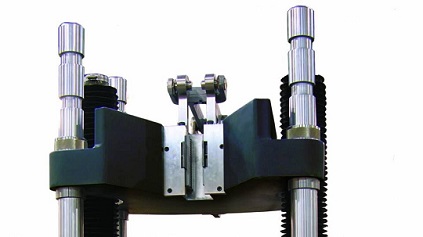
When a rope recoils upon breaking, the structure of test equipment must absorb the energy. Broken welds may appear in the structure so regular inspection is required.
Most test frames are designed for compressive loads but recoil impact is in the opposite direction and under shock conditions.
Protective barriers:
Cages over the testbed are appropriate, but they must not be considered “bullet-proof”, especially for large ropes that may have a strength and to as much as 1000 tonnes.
Broken fittings or metal objects are the most dangerous, and although breakage is rare, they can easily tear through most cages that have been installed over test beds.
Testing Strength evaluation dominates, by far, all the tests that might be run on fibre ropes. This seems obvious since when anyone thinks of any kind of rope, the first thing that comes to mind is, ‘How strong is it?’. However, there are many other tests that are conducted to measure the various properties of fibre ropes or those of the fibres from which they are made. Some of these properties may be more important than strength alone in certain applications.
Reasons for testing
Background: The reasons for conducting tests are as varied as the tests themselves. This background is useful for gaining an appreciation of the significance of testing in the developments, production, and use of the rope. Some of the more important tests are discussed in other points.
Quality Assurance: An acceptable quality assurance programme for rope production requires frequent type treatment, performance specification, and size. During the various stages of production, the ply count and twist levels of the rope components should be checked at some specified frequency.
Design and Specification: Fibre ropes often cannot be reliably designed to meet a specific strength specification without verification by testing. Unless changes from a known design are relatively small, knowledge of just the fibre properties may not be enough to accurately predict the strength of a new product. Also, strength will vary with size but not always in ratio with the amount of fibre present in cross-section.
Residual Strength: All Fibre ropes gradually lose strength and extensively with use. Knowledge of rates of degradation is important for safety and economy. A number of tension-tension fatigue tests on large ropes have been carried out in the joint industry studies sponsored by offshore oil-related organizations interested in deep sea mooring. These have been useful in gaining an understanding of the behavior of the particular ropes that were tested in this specialized application.
Research or Special Applications: Testing for various forms of fatigue and creep is usually done under research programmes to make life predictions. Sometimes a test programme will be undertaken for one specific application, such as deep sea mooring of floating oil production platforms.
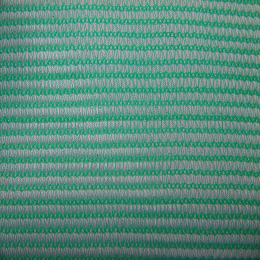
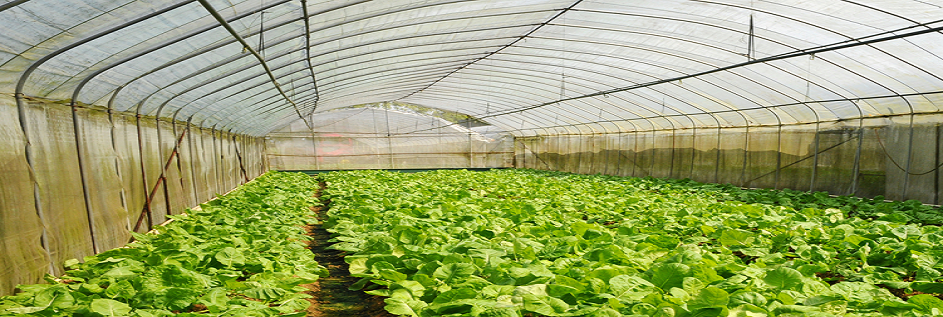
Each plant has its individual requirements for sunlight and shade under which it flourishes at its best. To create optimum climatic conditions, selection of the correct percentage of shade factor plays an important role to enhance plant’s productivity to its optimum.
Uses of Shade Net
Helps in the cultivation of flower plants, foliage plants, medicinal and aromatic plants, vegetables & spices.
Used for raising nurseries of fruits and vegetable.
Helps to enhance yield during the summer season.
Protection against pest attack.
Protects crops from natural weather disturbances such as wind, rain, hail, frost, snow, bird and insects.
Used in production of graft saplings and reducing its mortality during hot summer days.
Used for hardening tissue culture plants.
Helps in the quality drying of various agro products.
Helps in creating a favourable microenvironment for production of Vermicompost.
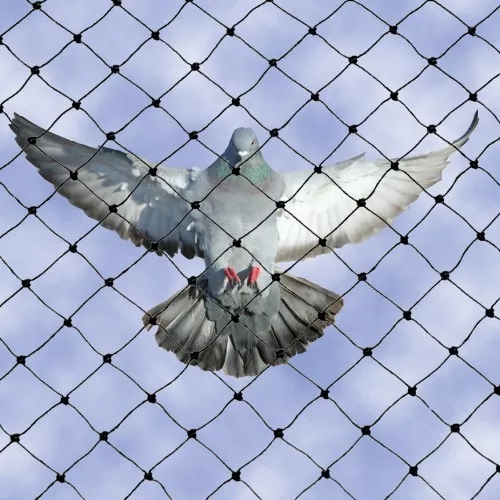
Birds are one of the top problems of the agricultural production in the country. Not only do birds interrupt crops, they can also ruin your garden, the school’s playground, the parking lot in your work, and many more locations where birds exist.
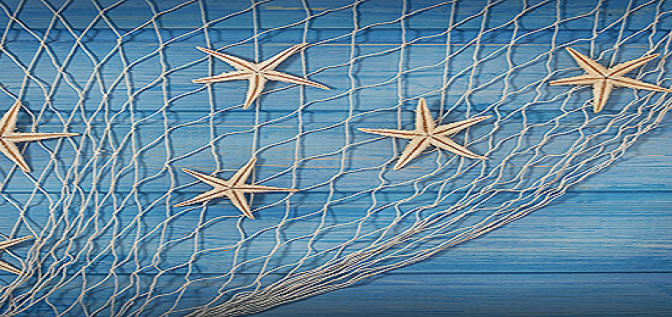
There are many products that could help you with your problem. There are a number of pesticides and other machinery that could be used to prevent pest birds. But there are also many good birds that do not cause damage, and may even help to pollinate your crops and garden or control smaller pests such as bugs. What, therefore, is the safest way to control the population of problem birds without interfering with the populations of the good birds? Bird netting is your answer.
Bird netting has many advantages, such as –
1. Health Issues There have been studies that birds could give illnesses when droppings get in contact with people’s skin. Pigeons, for example, carry infectious diseases. These pigeons could give people tuberculosis, flu, paratyphoid, Lyme-disease, Toxoplasmosis, and Encephalitis. By making sure that these pigeons do not spread their diseases, bird netting could put an end to your health worrying.
2. Protecting Plantation Most birds tend to peck on your fruits, vegetables, and plants because they know that these are food. Do not underestimate the birds. Protect your plantation with bird netting, so your plants are fenced safely away from their prying beaks.
3. Save The Birds The best advantage bird netting has is it is environmentally friendly. By making use of bird netting to protect your property, you are not killing the birds. You are simply covering up the location with a net for the birds to stay away. Unlike other methods of pest control, bird netting does not harm the birds. Pesticides and aroma repellants terminate the birds permanently. Plus, there are laws regarding the harming of birds like robins and blackbirds. Using bird netting, you are abiding the law!
4. Bird netting is versatile – Large spaces such as buildings parks, and plantations
– Small spaces like backyard or a rose garden
– Agricultural farms and plants
– Impressive variety of bird netting products
– A single bird net can be used for as long as ten years
– Variety of colors
– Variety of materials available (usually polyethylene strings or steel, to withstand extreme weather conditions)
– Prices of bird netting range from $150 to $8000 dollars
Bird netting is the smartest and most affordable way to repel birds in your area. One final note – be aware that an absence of birds may cause your garden to be a safe haven for bugs and other smaller pests that would otherwise have been controlled had the birds have access to the area. Bird netting does not 100% guarantee the livelihood of your protected area.
For many eukaryotic introns, splicing is carried out in a series of reactions which are catalyzed by the spliceosome, a complex of snRNPs. Self-splicing introns, or ribozymes capable of catalyzing their own excision from their parent RNA molecule, also exist.
Self-splicing occurs for rare introns that form a ribozyme, performing the functions of the spliceosome by RNA alone. There are three kinds of self-splicing introns, Group I, Group II and Group III.
Group I and II introns perform splicing similar to the spliceosome without requiring any protein. This similarity suggests that Group I and II introns may be evolutionarily related to the spliceosome. Self-splicing may also be very ancient and may have existed in an RNA world present before protein.
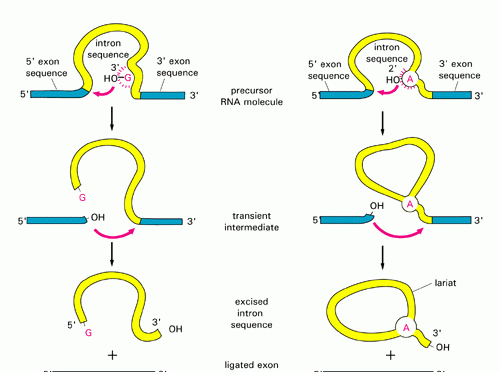
Two transesterifications characterize the mechanism through which group of introns is spliced:
3’OH of a free guanine nucleoside (or one located in the intron) or a nucleotide cofactor (GMP, GDP, GTP) attacks phosphate at the 5′ splice site.
3’OH of the 5′ exon becomes a nucleophile and the second transesterification results in the joining of the two exons.
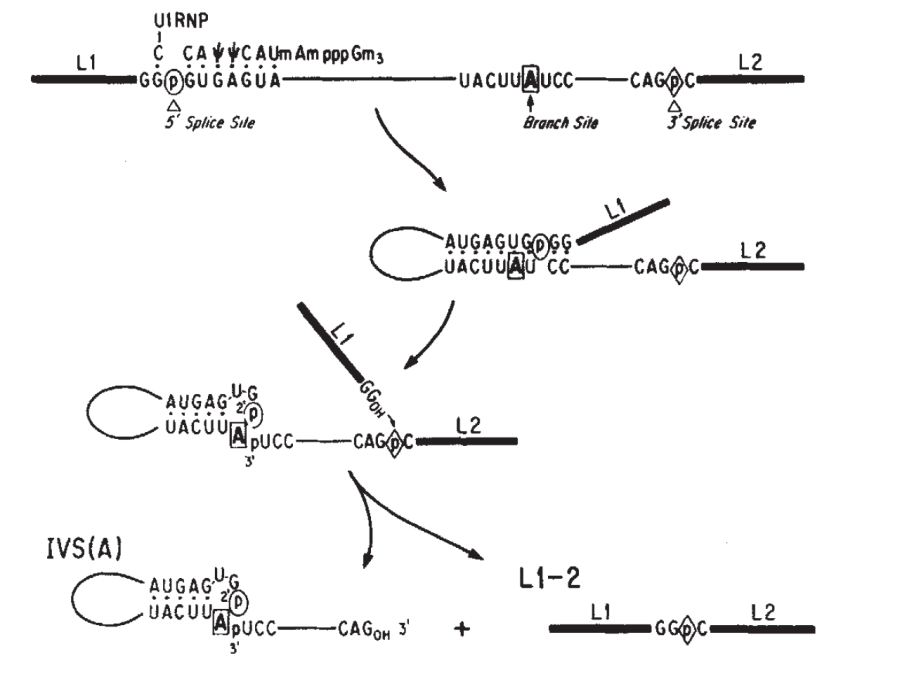
The mechanism in which group II introns are spliced (two transesterification reaction like group I introns) is as follows:
The 2’OH of a specific adenosine in the intron attacks the 5′ splice site, thereby forming the lariat
The 3’OH of the 5′ exon triggers the second transesterification at the 3′ splice site, thereby joining the exons together.
For a rope to transmit force it needs a termination, whether it is a permanent attachment, such as a splice, socket or mechanical grip, or a temporary fix, such as a knot or wraps around a post.An effective termination is essential to almost every application that puts a rope under tension. Splicing
Splicing can be used in three ways. An eye spice puts a loop at the end of a rope. An end-to-end splice can either join two ropes together or, finally, join two ends of the same rope to make a circular grommet.
Fibre rope splicing is a skill that must be learned. The simpler splices can be produced by carefully following a manual.
Small practices that are learned from experience or by testing of the splices are often needed to produce the best results.
A well-practiced expert can make splices that match rope strength.
The most common and one of the most dependable methods of terminations of the fibre ropes is an eye splice, which can be placed round a suitable fitting.
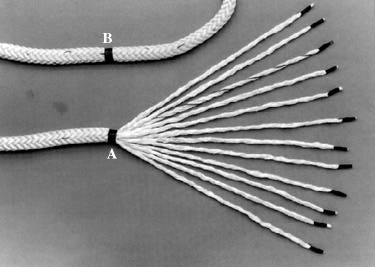
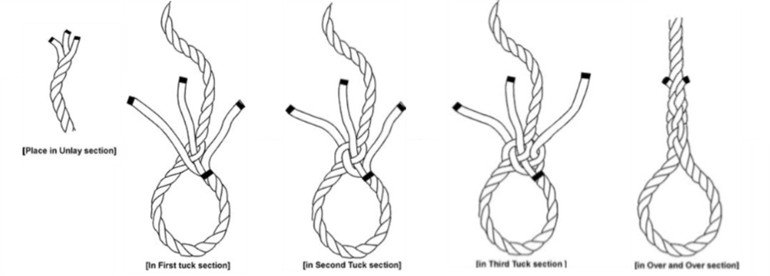
Splices are made by separating the strands at the ends of the rope from the structure, bending the rope into a loop and tucking the separated strands into the body of the rope.
Another approach is to separate the strands, create an eye, and then braid them over the exterior of the rope; this over-braid will tighten and grip as tension is applied to the eye.
An intermediate stage of tucking the strands is an eight-strand plaited rope. There is enough grip on the tucked strands to hold considerable tension, usually to the maximum breaking strength of the rope.
Polypropylene (PP) conjointlyreferred to asplastic, may be a thermoplastic chemical compoundemployed ina goodstyle of applications. Associate in Nursing addition chemical compoundmade of the chemical compound propene, it is oftencreatedin an exceedingstyle of structures giving rise to a range of applications as well as packaging and labeling, textiles, plastic components and reusable containers of assortedvarieties, laboratory instrumentation, automotive elements, and medical devices. It’s a white, automatically rugged, and proof against several chemical solvents, bases, and acids.
In 2013, the worldwidemarketplace forpolypropene was concerningfifty-five million tones. Polypropeneis that the world’s second-most widecreatedartificial plastic, oncepolythene.
History
Phillips crude chemists J. Paul Hogan and Robert Banks 1st polymerized propene in 1951. Propene was 1stchemical compounded to a crystalline isotactic polymer by Giulio Nattaalso as by the German chemist Karl Rehn in March 1954. This pioneering discovery junction rectifies the large-scale business production of isotactic polypropene by the Italian firm Montecatini from 1957 forrader. Syndiotactic polypropene was conjointly1st synthesized by Natta and his coworkers.
After polythene, polypropeneis that themost vital plastic with revenues expected to exceed US$145 billion by 2019. The sales of this material as forecast to grow at the rate of 5.8% p.a.till 2021.
Chemical and physical properties
Polypropylene is in several aspects almost likepolythene, particularly in answer behavior and electrical properties. The methyl improves mechanical properties and thermal resistance, though the chemical resistance decreases. The properties of polypropenerely on the relative molecular mass and relative molecular mass distribution, crystalline nature, sort and proportion of comonomer (if used) and therefore the isotacticity. In isotactic polypropene, for instance, the alkyl groupteamsashomeward on one facet of the carbon backbone. This arrangement creates a bigger degree of crystallinity and leads to a stiffer material that’sadditionalproof against creep than eachneurological disorder polypropene and polythene
There are certainly more applications than listed but this should be enough to convince you that rope and paracord are important and essential survival tools.
Rappelling – Being able to move quickly and efficiently is so important in any survival situations and sometimes this involves conquering a steep hill or cliff. A rope will allow you to safely rappell when needed using proper technique.
Build a Shelter – You can use rope to secure bundles of sticks and make walls and roofing for shelter.
Build a Raft – If you need to cross a river or travel downstream having rope will significantly increase the ease of constructing a useful flotation vessel.
Carrying – Strap tools and items to your backpack or clothing to be able to carry more things and keep your hands free.
Trip Wire – Making a trip wire with a can and rocks or bells can help ward off or alert you of animal threats like bears or wolves.
Clothing Line – Dry your clothing on the line after a heavy rain or encounter with a body of water.
Food Line – Hang your food up to avoid losing your meals to bears and other wild animals.
Tourniquet – If cut or wounded a rope can help stop serious bleeding when needed.
Fishing Line – You can use individual strands to use as fishing line if you have some type of bait and hook.
Fishing Net – Use the thin strands to consruct a small fishing net to catch fish for food.
Animal Trap or Snare – Catch prey by constructing a trap or snare of some type
Bola – A bola is a type of weapon that can be used to catch large birds or other animals for food.
Pulley System – Sometimes you may need to move large or heavy objects and rigging a type of pulley system may be the safest and most effective way to do so.
Fire Starting – You can make a bow drill to start a friction fire.
Tying Down – Secure your items, shelter, rafts, etc… by tying them down so they don’t get blown away by strong winds or washed away by running water.
Belt or Suspenders – Loose pants? Fix it by using a rope for a belt.
Shoe Laces – You can pull out some strands if your rope is too thick to replace broken shoelaces.
Zipper Pull – Tie a small knot through your zipper to help pull it.
Animal Leash – If you have a pet along or want to keep an animal you find restrained, use a rope as a leash and/or collar.
Ladder – You can use a rope as a ladder if you need to get up and down certain features like a large tree, rock face, or steep hillside.
Human Leash – In areas subject to landslides, avalanches, or quicksand, it is sometimes a safe practice to stay connected with a buddy by loosely tying or holding each end of a rope.
Hammock – A hammock is sometimes necessary bedding if you need to be elevated off the ground when sleeping to avoid dangerous threats such as insects, snakes, or wild animals.
Arm Sling – Make a sling in case of arm injuries.
Splint – Make a splint to secure broken bones.
Repair – Use the threading to repair clothing, shelter, or storage packs when needed.
Snow Shoes – Use a small branch or stick to create a makeshift shoe bottom for use in snow.
Grip – Use to make a grip around a walking stick or makeshift knife or tool.
Signaling – Tie signal devices like bright cloth to tops of trees as a rescue signal technique.
Crochet – Use the threads to knit into a backet or washcloth.
Dental Floss – The thin threads can be unwoven and used as a dental floss for hygiene purposes.

 Right from decorating the interiors to the use in industries, Ropes have become the versatile product worldwide.Never leave any strand of thread wasted you never know where it finds its utility. Ropes and knots are among the most ancient and useful technologies ever developed by man, predating the wheel, the ax and probably also the use of fire.These days Ropes are used in every sphere of life. Their usage is indispensable in every sector of life. We are present in all the activities of your life.Reaper Binder Twine: The flour which people consume in all the meals of the day is usually of wheat. Azuka’s
  To the numerous calls we do every day, the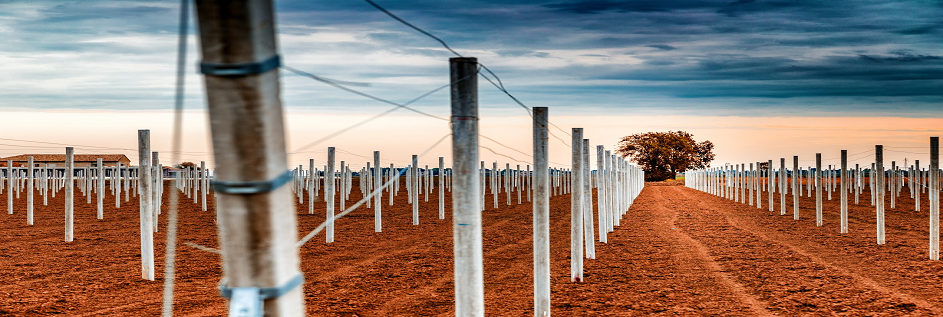
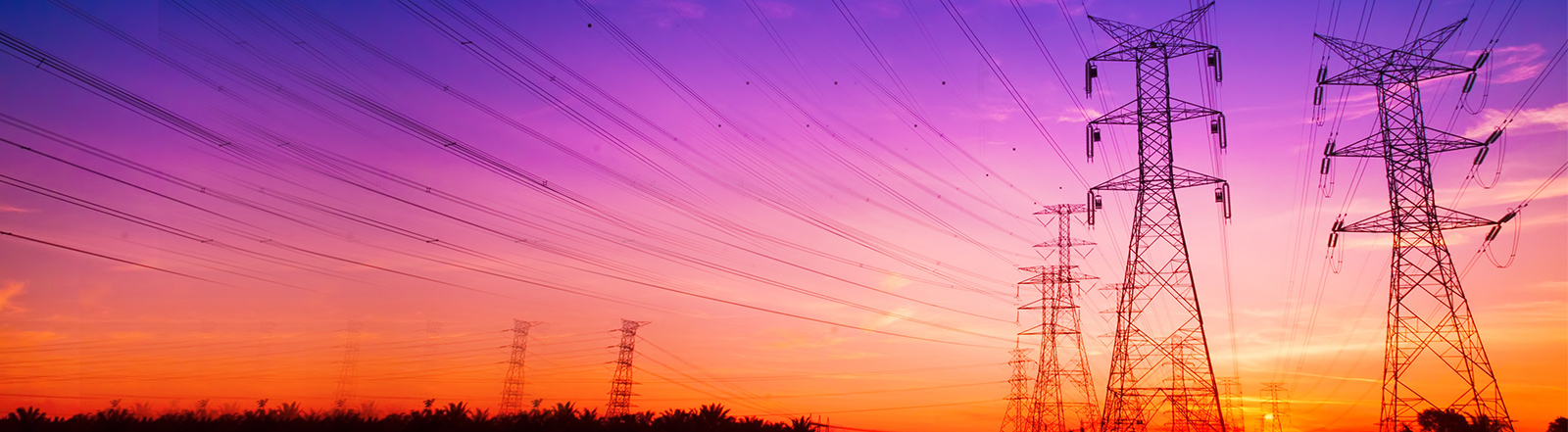 Clothesline Ropes: For drying of clothes,
  To deal with the journey of weight loss and fitness, The
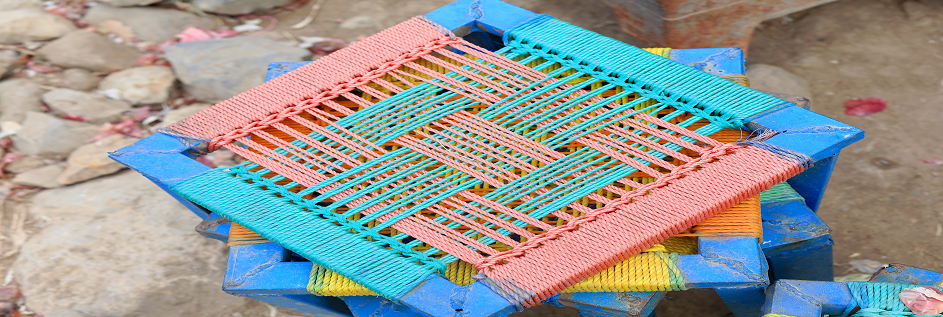
  Charpoy Rope used in urban as well as in rural areas these days.
  Conclusion:
A rope is a thread which has connected all the activities of our daily life.
Every sector of daily life is connected to each other with a “rope”.
Conclusion:
A rope is a thread which has connected all the activities of our daily life.
Every sector of daily life is connected to each other with a “rope”.